9.27
collisions per year, approximately, in the UK Continental Shelf.
HSE RR1154 (2019), Section 3.2.6, p. 25 (Table 20).
Field Management for Oil & Gas
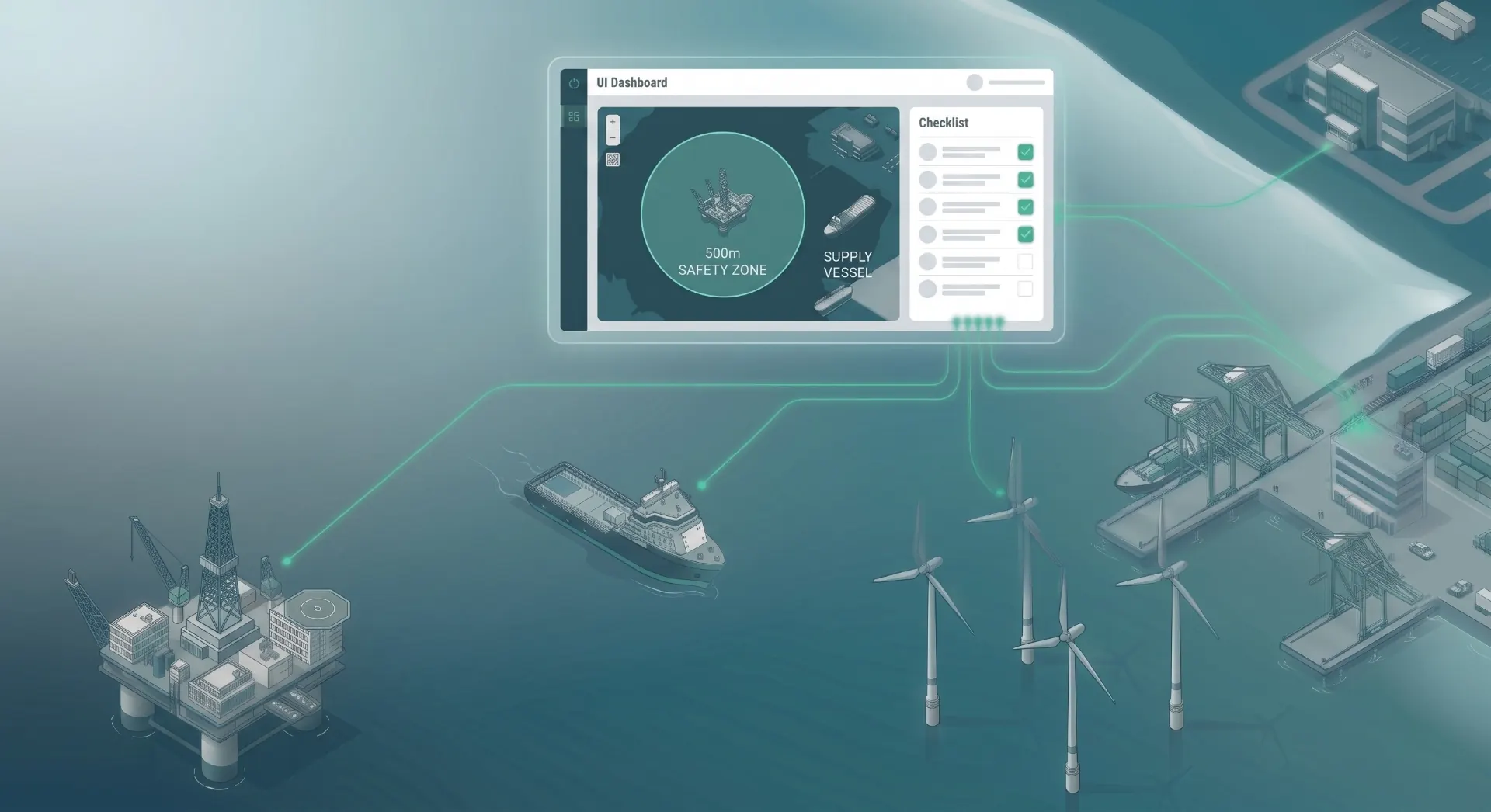
GreenHulls connects vessels, offshore assets and shore teams in one real-time operational view. Logic-driven safety gates reduce siloed decision-making and make compliance easier to follow.
9.27
collisions per year, approximately, in the UK Continental Shelf.
HSE RR1154 (2019), Section 3.2.6, p. 25 (Table 20).
98.6%
of collisions involve an authorised vessel invited into the 500m safety zone.
HSE RR1153 (2019), Section 1, p. 11.
1 in 8
forces immediate, premature decommissioning and accelerated liabilities.
WOAD Historical Incident Database (1971–1995).
UK HSE guidance emphasises detecting and correcting human failures before adverse consequences occur (Safety Notice ED01-2025).
Built around the people in the field
UK HSE guidance emphasises managing potential human failures and detecting them before adverse consequences occur. SOMS is designed to support that proactive approach, not replace the Master’s or OIM’s authority.
The operational gap
Costly collisions still happen despite current mitigations. Disconnected communication, paper-based coordination and limited real-time spatial awareness can leave teams working from different information. Separate workflows, manual follow-up and records reconstructed after the operation add avoidable effort while limiting timely oversight.
A single real-time view across vessels, asset personnel and shoreside teams.
Real-time active safety, time-stamped hazard alerts and guided safety gates.
Zone entries, speeds, checklist steps and gate confirmations captured automatically, time-stamped and available for review, trending and compliance assurance.
The Upgrade
Potential for siloed operations due to nature of paper-based coordination and limited real-time spatial awareness.
Unified field coordination: installation, supply vessel and ERRV work from the same real-time view of the field, so spatial awareness is shared rather than reconstructed over the radio.
Reliance on “left-hand” static barriers alone — training, procedures and basic assurance — with little that acts during the operation itself.
Adds an active barrier alongside the static ones: live safety-zone monitoring, logged entry breaches and time-stamped hazard alerts that intervene while the operation is still in progress.
Human factors, varying field management practices and loss of situational awareness during critical manoeuvres, with reliance on crew training and competence to make the right decision every time, even in high-stress situations.
Designed to make the right decision easier at each step: guided safety gates prompt the correct sequence, and a distraction-free interface keeps attention on seafaring rather than paperwork.
Unverified third-party static paper checklists that can be subject to maloperation, with no assurance they match your expectations.
Standardised, logic-driven digital workflows: dynamic gates guide every visiting vessel through your rules and guidelines, with the records captured as the work happens. A one-tap safety notification message can be sent to all relevant parties for the operation, keeping everyone in the loop as it happens, with the message, acknowledgements and subsequent response time-stamped and recorded.
Compliance blind spots due to limited visibility and manual oversight, with records assembled after the fact.
Proactive HSE and regulatory compliance assurance built on operational records captured during the job, not reconstructed from separate sources afterwards.
Fragmented logs across paper, email and separate systems. Radio clearances leave no record, so investigations and audits rely on memory and manual reconstruction, and trends across visiting vessels are difficult to see at all.
Zone entries and exits, vessel positions and speeds, checklist progression, safety-gate confirmations, safety notification messages and sign-offs are captured automatically and time-stamped. That supports step-by-step review of an operation after the event, trending across visiting vessels and seasons, and review of how barriers performed in practice.
Safety case barriers
Safety case bow ties set out the preventative and mitigating barriers around vessel operations. As an industry, it can be difficult to ensure passive barriers such as procedures, checklists and field-management controls are effectively communicated and acted upon in every instance during a live operation.
SOMS is designed to support those existing barriers through a shared operational view, guided workflows, safety notifications and time-stamped records.
Permissions, safety gates and operational steps are shared with the relevant parties as the work progresses.
Safety-zone activity, vessel speeds, confirmations and safety notification messages are captured and time-stamped during the operation.
Technical authorities and HSE teams can review how procedures and controls were applied across operations, visiting vessels and seasons.
Book a 15-minute walkthrough tailored to your business. Early partners get prioritised onboarding and direct input into the SOMS module roadmap.
Rapid deployment with no heavy IT integration required. Connects seamlessly with your existing tech stack.