266
asset damage events per year, representing 15% of all reported offshore wind safety events.
G+ Global Offshore Wind Health & Safety Organisation 2025 Incident Data Report (Energy Institute, pp. 7-8).
Field Management for Offshore Wind
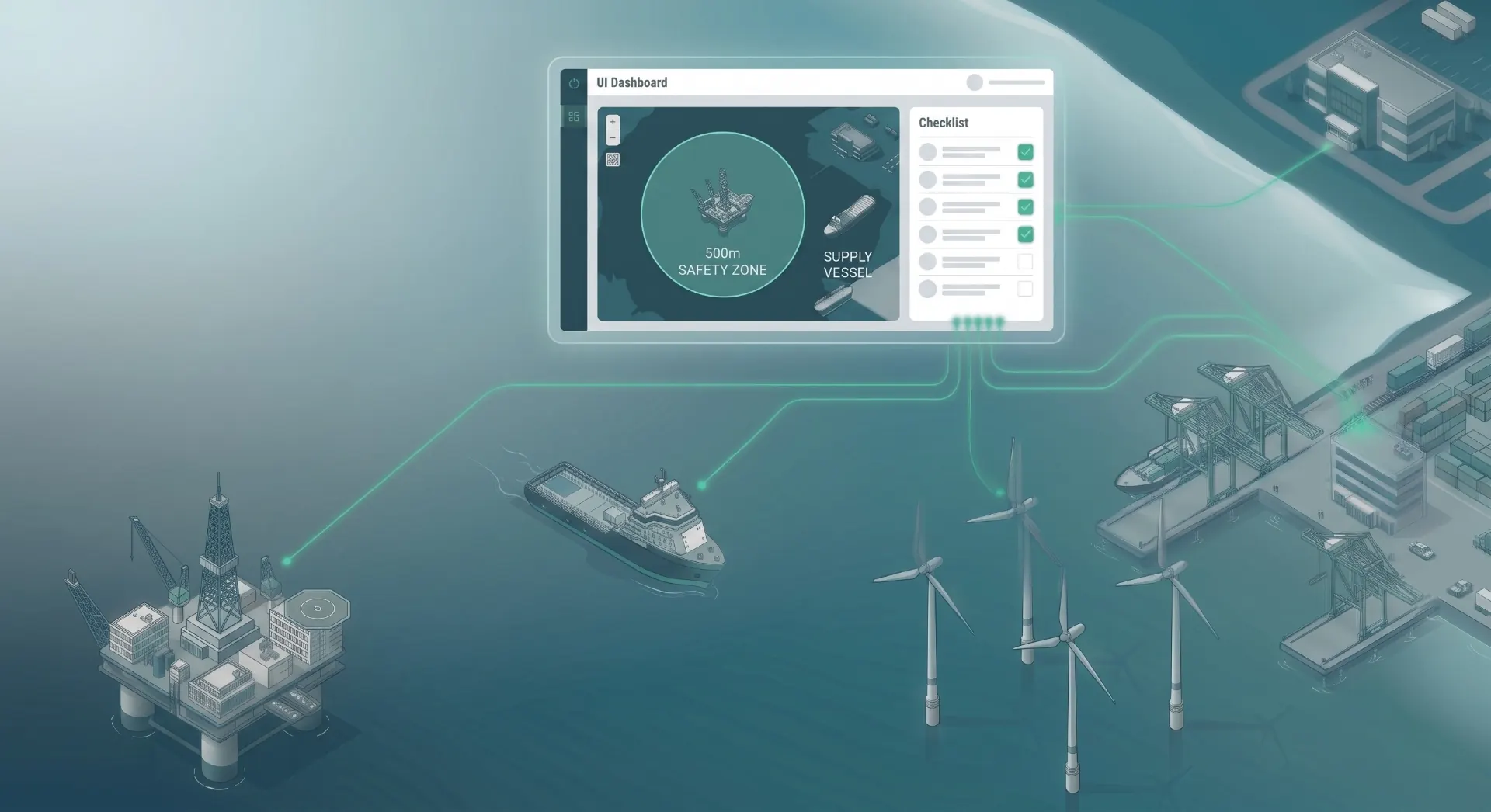
GreenHulls connects vessels, offshore assets and shore teams in one real-time operational view. Logic-driven safety gates reduce siloed decision-making and make compliance easier to follow.
266
asset damage events per year, representing 15% of all reported offshore wind safety events.
G+ Global Offshore Wind Health & Safety Organisation 2025 Incident Data Report (Energy Institute, pp. 7-8).
62%
of all vessel incidents on construction sites result directly in physical asset damage.
G+ Global Offshore Wind Health & Safety Organisation 2025 Incident Data Report (Energy Institute, p. 22).
UK HSE guidance emphasises detecting and correcting human failures before adverse consequences occur (Safety Notice ED01-2025).
Built around the people in the field
The difference
Tasking and clearances split across email (not accessible at the DP desk) and uncontrolled instant-messenger groups. During multiple-vessel operations, each vessel maintains its own typically unconnected checklist for the same operation.
Vessels, asset personnel, shoreside teams, HSE and project teams share one real-time view of the field.
Reliance on passive barriers such as procedures and basic assurance, with field entry breaches and speed limits not always monitored or adequately controlled during the operation itself.
Adds an active barrier alongside the static ones: live field monitoring, logged entry breaches and speed limits, and time-stamped hazard alerts that intervene while the operation is still in progress.
Vessel checklists aren't typically assured by the operator or reviewed against expectations; routine assurance visits don't typically cover this.
Standardised pre-built checklists with records and data captured during operations, including logged breaches.
Varying field management practices and loss of situational awareness during critical operations, with reliance on individual crew competence and training to make the right decision every time, even in high-stress situations, and no system-level safeguard if a step is missed.
Designed to make the right decision easier at each step: guided safety gates prompt the correct sequence, and a distraction-free interface keeps attention on the work rather than paperwork.
Compliance blind spots from limited visibility and manual oversight, with records obtained later from separate sources after an incident, regulator or the client asks.
Proactive HSE and regulatory compliance assurance built on operational records captured during the job, not reconstructed from separate sources afterwards.
Safety case barriers
Procedures, vessel checklists and field-management controls are important barriers across offshore wind projects and operations. As an industry, it can be difficult to ensure these passive barriers are effectively communicated and acted upon in every instance, particularly when several vessels support the same operation.
SOMS is designed to support those existing barriers through shared coordination, guided workflows, safety notifications and time-stamped records.
Tasking, clearances, checklists and operational steps are shared with the relevant parties through one live view.
Field entry, vessel speeds, confirmations and safety notification messages are captured and time-stamped during the operation.
HSE and project teams can review how procedures and controls were followed across operations and participating vessels.
Book a 15-minute walkthrough tailored to your business. Early partners get prioritised onboarding and direct input into the SOMS module roadmap.
Rapid deployment with no heavy IT integration required. Connects seamlessly with your existing tech stack.