Executive Summary
The Operational Data: Historical O&G UKCS ship/platform collision research published by the Health and Safety Executive (HSE), including Research Reports RR1153 and RR1154, indicates an estimated average of 9.27 incidents per year, with 98.6% of recorded collisions classified as involving "attendant vessels", which are vessels approaching an installation for a bona fide reason after seeking permission.
The Management Challenge: The 500m Safety Zone is not, by itself, a complete collision-risk control; it is one part of a wider operating framework in which multiple controls must remain effective. Industry guidance, including the Guidelines for Offshore Marine Operations (GOMO), the MSF 500m Safety Zone Marine Responsible Person Guidance, IMCA 182 MSF, and Step Change in Safety's Marine Operations: 500m Safety Zone Guidance, provides established guidance and controls for vessel selection, pre-entry checks, set-up, working, and exit. Step Change in Safety guidance emphasizes that communications should be established before entry and maintained throughout the operation, while vessel station keeping, operational conditions, weather and environmental conditions, and trigger points should continue to be monitored during work inside the zone. Completing a pre-entry check confirms that defined equipment and operating conditions have been assessed at a specific point in time; it does not, by itself, establish that those conditions will remain unchanged throughout live operations. The ongoing challenge is maintaining the effectiveness of these controls as conditions, work scopes, vessel status, and operational priorities change.
What ED01-2025 Highlights: The UK Health and Safety Executive HSE Safety Notice ED01-2025 highlights five offshore case studies in which collision risks developed during operations, including cases involving loss of situational awareness, distraction by non-navigational tasks, changing environmental conditions, and communication failures during live operations.
The Operational Layer: Technology platforms like GreenHulls SOMS are designed to provide a technology-enabled coordination layer, helping connect established procedures and operational checks with live field execution across Communication, Coordination, and Workflow. While such integrated digital coordination platforms represent an emerging approach within the industry and are not yet universally adopted, they offer a structured method to support live marine operations.
1. Pre-Entry Clearance Is Part of a Continuous Process
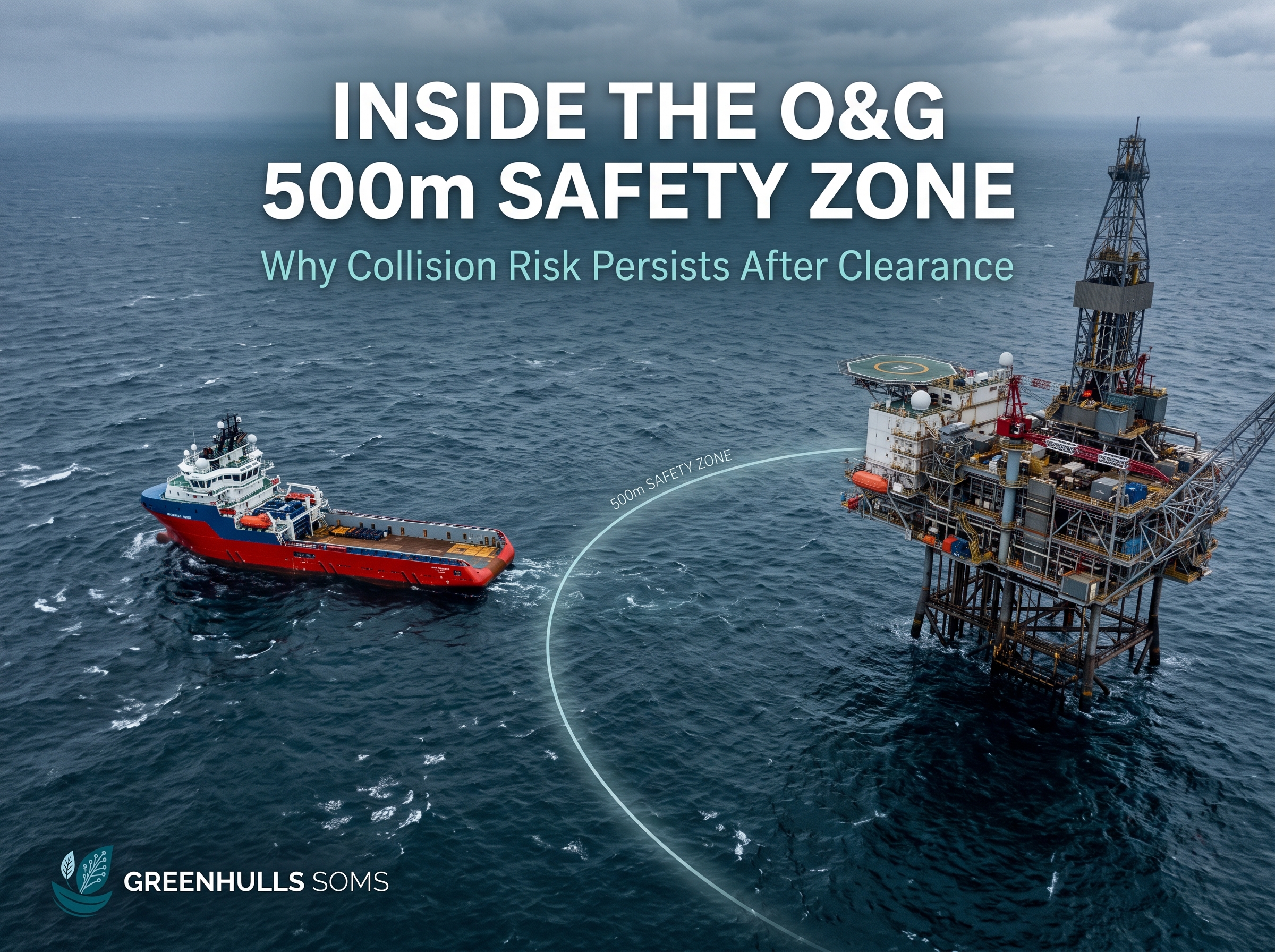
For operations where a 500m Safety Zone and associated marine-control procedures apply, the operating process extends beyond initial entry clearance to encompass an operational sequence: pre-entry checks, set-up, working, and exit. Step Change in Safety guidance sets out these stages explicitly, underscoring the importance of continuous monitoring of vessel station keeping, environmental conditions, communications, and operational changes while the vessel is within the zone.
Completing a pre-entry check establishes that defined equipment and operating conditions have been assessed at a specific point in time. However, obtaining clearance to enter does not mean operational conditions will remain static.
Once permission is granted and the vessel moves from the set-up position into the working location, the operating environment remains dynamic:
Metocean forces can shift, altering thruster demand and vessel handling characteristics.
Work scopes can change, potentially introducing or altering simultaneous operations (SIMOPS) involving adjacent assets.
Administrative duties, radio chatter, and deck coordination can place heavy cognitive demands on bridge watchkeepers.
Pre-entry clearance is a critical operational hold point, but the ongoing challenge for Duty Holders, Marine Superintendents, Marine Responsible Persons, and other operational teams is maintaining procedural structure and situational awareness throughout the entire execution phase.
2. From Technical Failure to Human Factors: What ED01-2025 Adds
Technical failure modes, such as Dynamic Positioning (DP) drive-offs, thruster dropouts, or main propulsion faults, traditionally receive significant attention in offshore marine risk management. HSE Safety Notice ED01-2025 adds an important dimension: even where technical systems, marine assurance, and pre-entry controls are established, human factors, watchkeeping practices, and communication gaps can still create a developing collision risk during execution.
The five case studies outlined in ED01-2025 illustrate how these operational risks develop across four distinct failure modes:
Watchkeeper Distraction and Non-Navigational Tasks: In multiple cases, Officers of the Watch (OOW) or lookouts were diverted by administrative tasks, such as writing meeting minutes, testing bridge radios, or using bridge computers, while vessels drifted off position or onto collision courses.
Inadequate Bridge Team Communication: During SOV transits inside wind arrays, communication gaps between bridge team members during heading changes contributed to uncoordinated manoeuvres before command intervention occurred.
Changing Operational Scope: Unplanned operational changes requested during live cargo transfers alongside drilling units contributed directly to position-keeping failures.
Speed and Control Management: Even after completing pre-entry checklists, operational errors during close-proximity manoeuvring resulted in an increase in vessel speed prior to impact.
Importantly, HSE notes that, in all five cases, the duty holders chartering the vessels had marine assurance processes in place. The notice highlights that shore-based assurance activities, including vessel visits while in port, may not be sufficient to identify poor watchkeeping and Bridge Resource Management practices that emerge during live operations.
3. Maintaining a Common Operating Picture Across Field Operations
Offshore field management involves multiple operational teams and decision points: vessel bridge crews, pre mobilisation briefing/survey personnel, installation control rooms, crane operators, marine coordinators, and shoreside logistics teams.
Established industry guidance, including material from Step Change in Safety, the Marine Safety Forum (MSF), and GOMO, provides established frameworks and guidance covering areas such as joint risk assessment, communication, and marine operations. Relevant industry guidance also emphasises that vessel Masters should not be subjected to pressure to operate in marginal conditions, and that vessels should be moved to a safe location when conditions or operational delays make continued close-proximity working inappropriate.
In practice, however, applying these principles during live operations can create real human and operational friction. Vessel crews work within commercial and operational pressures, and initiating a stand-off or stopping an activity can introduce a difficult decision, particularly when the immediate consequence is delay. In marginal conditions, the practical decision can become uncomfortable: whether to continue for another few minutes, or to stand off and accept the resulting delay.
The control may therefore exist within the SMS, marine procedures, and operational guidance, but its effectiveness still depends on someone recognising the condition, making the decision, communicating it, and ensuring that the wider team understands what happens next. This is where the "awkward call" becomes a field-management issue.
Compounding this human friction is information fragmentation. Depending on the installation, operation, and organizational arrangements, each team may hold a different part of the overall operational picture:
The vessel bridge team monitors local thruster loading, wind vectors, and deck activity.
Installation control rooms and work teams may hold information on platform activity, overside work, and crane operations.
Marine coordination teams may monitor field-wide vessel positioning alongside broader operational and weather information.
When the scope of an operation changes, reassessing risk or progressing a Management of Change process during live activity creates further friction. Trying to explain a revised scope, confirm controls, and establish who has agreed to what over a busy radio channel can be difficult and prone to miscommunication. The result can be a sequence of verbal confirmations, follow-up calls, paper permits and separate records, making it harder for everyone involved to maintain the same operational status in real time.
This operational fragmentation also weakens the learning loop. Paper-based checklists, permits, and handover records create a separation between the activity and the information used to manage it. A document may confirm that a check was completed, but that information is not necessarily visible to every team involved at the moment it matters. After the job, collecting, reviewing, and reconciling paper records across vessels, installations, and shoreside teams can require significant manual effort. This can make it more difficult to identify recurring patterns across operations, visiting vessels or work scopes, or to understand how safety controls performed in practice.
4. Supporting Established Controls During Live Execution
Industry guidance, including GOMO, IMCA 182 MSF, the Oil & Gas UK Guidelines for Ship/Installation Collision Avoidance, and Step Change in Safety, already provides extensive guidance and controls covering areas such as vessel suitability, crew competence, Activity Specific Operating Guidelines (ASOG), SIMOPS management, and contingency planning.
An important field-management challenge is how those established controls are connected to live activity as it unfolds.
ED01-2025 points towards a more active approach to monitoring. HSE recommends that duty holders and vessel operators review watchkeeping and bridge resource management arrangements, and consider automated systems such as AIS tracking, guard zones and automated alerts to monitor attendant vessel movements and detect unplanned approaches. While vessel tracking provides valuable information about where a vessel is, digital field-management platforms can connect that position with what the vessel is doing, what restrictions apply, what procedure governs the activity, what stage the operation is at, and what needs to happen next.
Platforms such as GreenHulls SOMS provide a technology-enabled coordination layer designed to help operators address these operational considerations. By connecting established procedures and operational checks with live field execution, GreenHulls SOMS supports field coordination across three core capabilities:
Communication: Provides a shared operational view across vessels, offshore assets, and shoreside teams to help reduce fragmented communication and support a common operating picture.
Coordination: Helps marine coordinators and field teams align vessel positioning, active work scopes, site restrictions, and operational activity as conditions change.
Workflow: Connects established safety procedures, operational checks, and hold points to live field execution through structured workflows, helping teams follow established safety gates and required steps as activity progresses.
By structuring relevant information and established checks around live activity, the platform is designed to help reduce avoidable administrative friction and support teams in maintaining procedural focus during execution. Capturing zone entries, speeds, checklist progression, safety-gate confirmations, and time-stamped sign-offs directly during the job can help reduce reliance on post-operation reconstruction, providing technical authorities and HSE teams with a more structured operational record that can support review of how controls were applied in practice.
The value is not that technology makes the operational decision on behalf of the Master, OIM, or Marine Coordinator. Rather, it helps connect the relevant information, procedure, and operational status to the people responsible for making and coordinating that decision.
A technology-enabled coordination layer cannot eliminate collision risk by itself; its role is to help mitigate operational risk by keeping relevant information, procedures, and checks connected to live activity.
GreenHulls SOMS does not replace the Vessel Master's authority, the OIM's responsibilities, the Marine Coordinator's role, or the written Safety Management System (SMS). It is designed to support operational assurance by providing a shared operational view that can assist decision-making.
Conclusion
The historical collision data, together with the cases highlighted by HSE Safety Notice ED01-2025, illustrate an important operational limitation: completing a pre-entry check does not remove the need for effective watchkeeping, communication, monitoring, and decision-making throughout the activity.
The wider lesson is that the effectiveness of a marine control depends not only on whether the procedure exists, but on whether the people responsible for the operation can keep that procedure connected to changing conditions and activity in the field.
For Duty Holders, Marine Superintendents, Marine Responsible Persons, and Marine Coordination Centres, an important part of mitigating this risk is keeping established Safety Management System procedures closely connected to live field execution.
Explore GreenHulls SOMS
Discover how GreenHulls SOMS can support your offshore operations by connecting procedures, people, vessels, assets, and live activity in one coordinated environment.
To discuss your field management requirements or schedule a technical walkthrough with the GreenHulls team, visit greenhulls.com or contact the GreenHulls team directly.